MVB: The system brands actually need
A Minimum Viable Brand (MVB) is the smallest system a brand needs to work in the real world.
It starts with clear strategic decisions (who it’s for, what it stands for, and the rules that protect those choices) and turns them into identity essentials (how the brand looks, sounds, and shows up).
When decisions and expression stay aligned, consistency emerges naturally. Not as effort, but as a result.
Founders understand MVPs instinctively. They know that without a working product, nothing else matters. They put discipline into it. They argue over it. They refine it relentlessly because they understand one thing very clearly: the product has to work before anything else has a chance.
That’s the blind spot.
Because long before your product gets a chance to prove itself, your brand is already doing the selling. It’s what earns attention. It’s what opens doors. It’s what gets you the meeting, the pitch, the second look.
In most cases, it’s the brand that carries the product into the room, not the other way around.
Most founders don’t think they have a brand problem. They think they have a sales problem, or a marketing problem, or a messaging problem. But those issues are usually symptoms. When you look closely, they almost always trace back to the same root cause: there is no shared system holding the brand together.
In the early days, this doesn’t feel like a problem. The founder holds the context. Decisions feel aligned because they’re coming from one mind. But as soon as more people get involved, designers, marketers, sales teams, agencies, interpretation replaces intention.
Everyone is doing their best, yet the brand starts to drift. Quietly. Gradually. Not because people are careless, but because the rules were never clearly defined.
This is where the idea of a Minimum Viable Brand comes in.
Minimum viable brand
A Minimum Viable Brand is not a stripped-down or temporary brand. It’s not “branding on a budget.” An MVB is the smallest complete brand system a business needs in order to function properly in the real world.
The same way an MVP prevents wasted product effort, an MVB prevents wasted growth effort. It gives clarity early, before complexity and scale introduce noise.
An MVB answers the questions teams keep revisiting. Who are we for? What problem do we solve best? What do we stand for? What must never change as we grow? When those answers are clear, decisions become easier, faster, and more consistent. Consistency stops being something you enforce and starts becoming something that naturally happens.
The irony is that this is the layer that actually makes everything else work better. Sales conversations shorten because the story is clear. Marketing becomes more focused because positioning is defined. Hiring becomes easier because people understand what they’re joining. Yet this is the layer founders tend to postpone, even though it compounds just as much as product does.
That becomes especially visible when money enters the picture. Venture capitalists don’t just invest in features. They invest in clarity, focus, and conviction.
81%* of investors cite “lack of clear positioning” as a key risk factor.
They want to understand quickly what problem you solve, who you solve it for, and why you’re the one that should win. A strong MVP matters, but a clear brand narrative helps them see the opportunity faster and with more confidence. A Minimum Viable Brand doesn’t guarantee funding, but it removes unnecessary friction from the conversation. It signals that the business is intentional, not accidental.
In the same way an MVP signals execution discipline, an MVB signals strategic discipline.
And yet, founders consistently underinvest in it.
They’ll iterate endlessly on features but hesitate to lock down positioning. They’ll stress-test onboarding flows but avoid making firm brand decisions. Not because the MVB matters less, but because its impact feels harder to measure — until it’s missing. When it’s weak, everything costs more. Sales takes longer. Marketing works harder. Pitches explain instead of persuade.
When it’s clear, the business moves with less resistance. Not because the brand is louder, but because it’s easier to understand.
You already apply MVP thinking to your product.
The same discipline, the same instinct to get the foundation right before scaling. applies to your brand. Most founders discover this after the fact, when sales is struggling to tell a consistent story and marketing is producing results that don't compound.
A Vision Clarity Session is where we assess whether your brand has the foundation it needs — or whether you're scaling on sand.
Book a Free Vision Clarity Session →
The MVB system
The Minimum Viable Brand is not a loose collection of elements. It is an ordered framework designed to hold together under real-world conditions. Each part plays a specific role, and each one builds on the last.
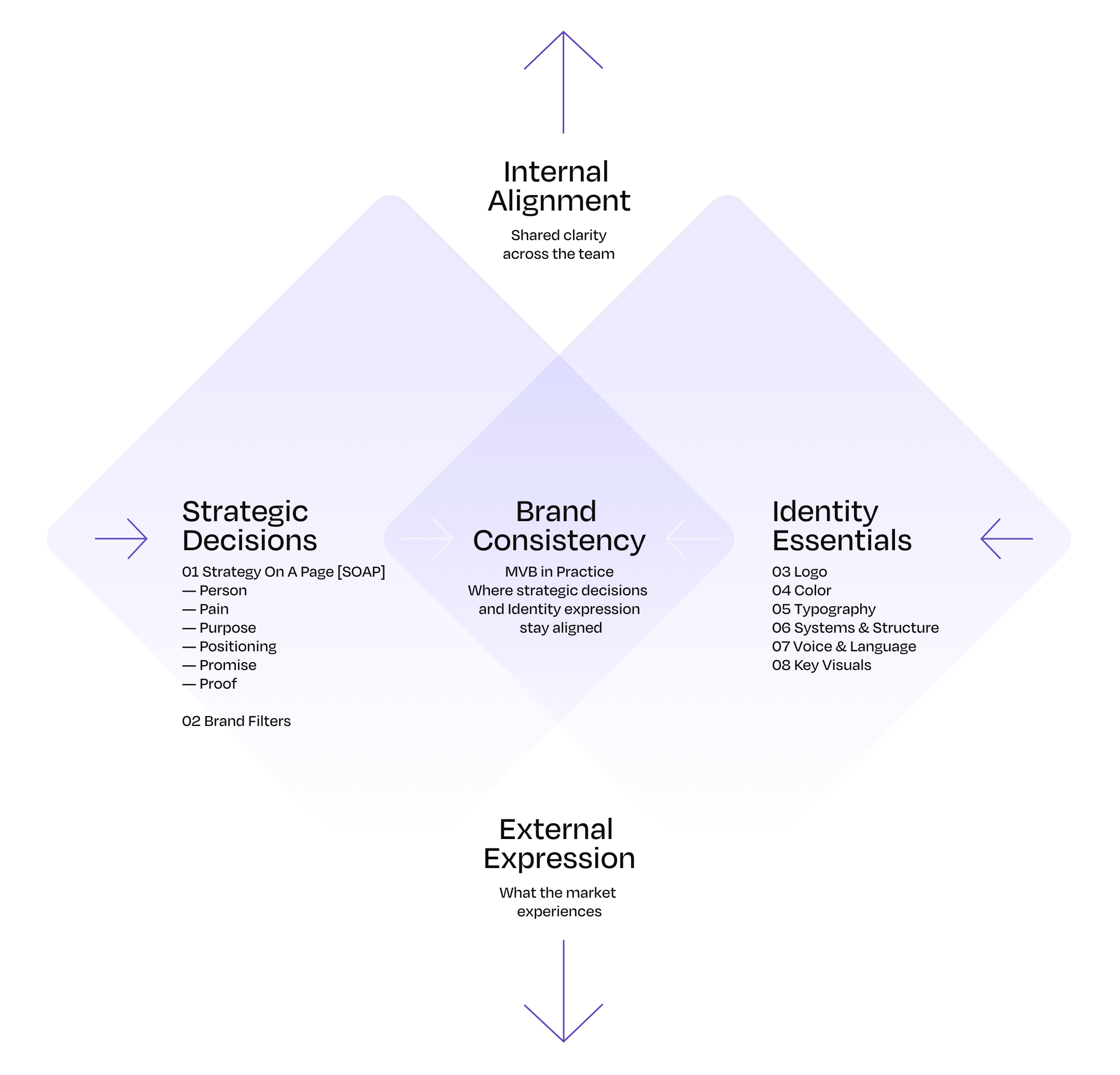
Strategic decisions
The choices that guide every brand decision.
1. Strategy on a Page
Audience, problem, purpose, positioning, promise, and proof, clarified in one view.
2. Brand Filters
Strategic guardrails that protect clarity as the brand grows.
What must never change. What can flex. What must scale.
Identity essentials
How strategic decisions show up in the real world.
3. Logo
The mark that carries meaning and anchors recognition.
4. Colour
The emotional shortcut that builds memory and association.
5. Typography
The visual voice — how the brand sounds on the page.
6. System & Structure
Patterns, layouts, and graphic logic that hold everything together.
7. Voice & Language
How the brand speaks. What it says. What it avoids.
8. Key Visual
The unified expression where all elements come together.
What the MVB does is simple. It gives your brand a spine before you add muscle. It turns branding from something you revisit repeatedly into something that quietly supports decisions as the business grows.
Founders already understand this logic when it comes to product. The Minimum Viable Brand applies the same thinking to the layer that actually carries that product into the market.
Part of a larger series
This article is part of an ongoing series on the Minimum Viable Brand. Each piece focuses on one layer of the system, breaking it down as working infrastructure rather than theory. Read together, the series is meant to help founders apply the same discipline they bring to MVPs to the brand layer that shapes growth, perception, and long-term success.
*framed across multiple HBR and PwC investor perception studies
If this article made you think about your own brand, that's worth a conversation.
Book a Free Vision Clarity Session →