Tone of voice isn’t how a brand sounds.
It’s how a brand thinks out loud.
When tone is treated as style, language drifts, approvals slow, and trust erodes.
When tone is treated as infrastructure, clarity scales.
Strong tone doesn’t come from adjectives or frameworks alone.
It comes from strategy, boundaries, and restraint.
If your brand sounds fine everywhere but convincing nowhere, tone isn’t missing.
It was never systemized.

Tone of voice is one of the most discussed elements of branding, and yet one of the least understood. It is frequently treated as a stylistic choice—an aesthetic layer applied after strategy has been set. Brands describe themselves using familiar adjectives such as friendly, bold, or professional, believing these words are sufficient to guide communication. The intent is usually sincere. The outcome rarely is.
Despite having a “defined” tone, brands struggle with inconsistency. Language shifts subtly across channels. Content feels uneven depending on who wrote it. Feedback loops become long and imprecise. Teams sense that something is off but cannot articulate why. The brand sounds acceptable everywhere, yet convincing nowhere.
This is not a failure of creativity or copywriting skill. It is a failure of structure.
A brand’s tone of voice is not how it sounds in isolation. It is the repeatable way the brand thinks and speaks across time, teams, and situations. It is not dependent on a specific writer, channel, or moment. If tone collapses when work is outsourced, new hires join, or AI tools are introduced, then it was never properly defined.
Tone of voice is not fancy copywriting.
It is infrastructure.
Chapter 1
Why tone of voice breaks as brands grow
As soon as language leaves the founder’s hands, inconsistency appears. Tone problems don’t start with writing—they start with scale.
At its core, tone of voice is a decision framework for language. It governs how messages are framed rather than what messages are delivered. It determines the brand’s posture in communication: how confident it is, how direct it is, how much emotional distance it maintains, and how it balances clarity with persuasion.
This distinction matters because language decisions are never neutral. Every sentence carries implicit signals about authority, confidence, intent, and trustworthiness. Tone of voice ensures those signals are deliberate rather than accidental.
Consider two brands communicating the same idea:
- “Our solution helps teams improve productivity.”
- “We help teams work faster, with less friction.”
Both statements are clear. Both are correct. Yet they signal very different postures. The difference is not copywriting quality. It is tonal intent.
Tone of voice does not dictate exact wording. It defines the conditions under which wording is chosen. Once those conditions are clear, different writers can produce different sentences that still feel aligned.

What tone of voice is not
Tone of voice is not a list of personality traits. Descriptors such as innovative, approachable, or trustworthy describe aspirations, not rules. They do not resolve ambiguity when interpretations conflict.
It is not a mood board translated into words. Visual inspiration can suggest feeling, but it cannot govern language decisions.
It is not a grammar or copywriting guide. Sentence mechanics matter, but they do not address alignment.
Most importantly, tone of voice is not a “vibe” people are expected to intuit. Intuition does not scale. Systems do.
A functional tone of voice must define constraints. It must make clear not only what is allowed, but what is not. If no one can explain why a sentence should be removed or rewritten, the tone is not operational.
Voice, tone, and messaging: Clear separation
Much of the confusion around tone of voice comes from conflating it with voice or messaging.
Messaging is what is being said: propositions, claims, proof points. It changes as offerings and markets evolve.
Voice is the brand’s stable personality in language. It does not change.
Tone is how that voice adapts to situation and audience state.
A brand with a calm, confident voice may use a reassuring tone in support, a decisive tone in a launch, and an accountable tone in a crisis. The emphasis shifts, but the brand remains recognizable.
Without this separation, brands either force the same language everywhere, becoming rigid, or allow each context to redefine how they sound, leading to fragmentation.

Why it exists
Tone of voice exists to reduce interpretation inside an organization.
Without tone clarity, every piece of communication becomes a negotiation. Feedback slows. Rewrites multiply. Language is diluted through compromise. Phrases like “this doesn’t feel right” persist, not because they are wrong, but because they lack shared criteria.
Tone of voice turns subjective reaction into objective alignment. It allows teams to assess language against agreed rules rather than personal taste.
From a business perspective, this reduces revision cycles, speeds approvals, lowers brand risk, and strengthens trust. Inconsistent tone, by contrast, creates hesitation. Even when the message is sound, inconsistency signals uncertainty.
Chapter 2
Where tone of voice really comes from
Tone can’t be invented in a workshop. It has to be derived from decisions the business has already made.
Tone of voice cannot be invented in isolation. It must be derived from strategy.
Every brand already has a tone. The difference between strong and weak brands is intentionality. Weak brands allow tone to emerge accidentally. Strong brands decide it deliberately.
Tone sits downstream of strategy. It reflects how a brand sees itself, how it sees its audience, and what role it believes it should play.
Several strategic inputs shape tone:
Vision or North Star
Vision defines posture. A brand oriented toward leadership speaks differently from one oriented toward support or exploration.
Example: Apple
Vision: Lead through design and innovation.
Tone of Voice: Calm, declarative, restrained.
Why it works: A leadership vision requires certainty. Apple’s tone avoids explanation and hype because leaders don’t need to convince, they set direction. The posture is authority, and the language reflects it.
Positioning and Only-ness
Positioning determines how a brand differentiates in language. Without it, tone defaults to category clichés.
Example: Surreal
Positioning: The cereal brand for people who hate cereal marketing.
Tone of Voice: Deadpan, self-aware, anti-hype.
Why it works: Surreal’s positioning rejects category clichés, so its tone openly mocks them. The language differentiates before the product does. Without this positioning, the same humour would feel gimmicky.
Audience reality
Tone must account for the audience’s emotional and cognitive state. Ignoring this almost always feels misjudged.
Example: Mailchimp
Audience reality: Users feel anxious and exposed when marketing.
Tone of Voice: Reassuring, plainspoken, supportive.
Why it works: Mailchimp reduces fear before selling capability. The tone meets the audience where they are emotionally, not where the brand wishes they were. That alignment builds trust.
Brand promise
Vague promises tolerate vague tone. Clear promises demand precision and restraint.
Example: Nike
Brand promise: Help you perform at your best.
Tone of Voice: Direct, declarative, uncompromising.
Why it works: Nike’s promise is action, not explanation. The tone mirrors that by eliminating qualifiers and justification. Saying less reinforces belief. Precision replaces persuasion.
Values and operating principles
Values determine how the brand sounds under pressure.
Example: Patagonia
Values: Environmental responsibility over growth at all costs.
Tone of Voice: Honest, accountable, sometimes uncomfortable.
Why it works: Patagonia’s tone remains consistent even when it challenges the customer. That restraint under pressure proves the values are real. The tone doesn’t soften the truth to protect sales.
The enemy
Defining what the brand refuses to sound like is one of the fastest ways to sharpen tone.
Example: The Economist
Enemy: Simplistic thinking and intellectual laziness.
Tone of Voice: Wry, confident, unapologetically demanding.
Why it works:
By refusing to sound accessible-for-everyone, The Economist sharpens its authority. The tone filters the audience deliberately. Rejection becomes clarity.
Tone becomes specific because strategy is specific.
Chapter 3
How tone of voice holds a brand together
When tone is systemized, language stops drifting. Clarity becomes repeatable, even as the brand grows.
The mistake most brands make is not choosing the wrong tone framework, but choosing one too early. Tone of voice only works when it is built in sequence: first the brand’s role is defined, then constraints are set, then those constraints are translated into language rules. Only after that do frameworks help. Reverse the order, and tone becomes opinion instead of infrastructure.
Apple: Clarity under restraint
Apple’s tone is often described as simple. More accurately, it is clear under restraint. Apple avoids inflated claims and unnecessary explanation. Language assumes authority rather than justifying itself. This works because the brand occupies a position of certainty. Without that position, the same restraint would feel evasive.

Mailchimp: Reassurance as strategy
Mailchimp operates in an anxiety-laden category. Its tone is deliberately reassuring. Errors are framed as normal. Instructions feel supportive, not corrective. Confidence is built by reducing fear, not amplifying ambition.

Nike: Conviction without explanation
Nike’s tone is declarative, not persuasive. “Just Do It” works because it does not hedge or explain. Nike plays the role of catalyst, not instructor. Explanation would weaken the message.

Innocent drinks: Warmth with limits
Innocent’s tone is playful but governed. Humour never obscures clarity. Warmth is permitted; cynicism is not. Without these boundaries, personality would overwhelm trust.

What these examples reveal
Effective tone is never arbitrary. It is anchored in strategy, shaped by audience reality, and enforced through restraint.
Tone determines how much explanation is needed, how confidence is expressed, and where emotional emphasis belongs. When tone is clear, language decisions feel obvious rather than debated. When it is not, even good writing feels uncertain.
Tone of voice does not exist to make brands sound interesting.
It exists to make them coherent.
Apply the diagnostic to your own brand right now.
Read your last proposal. Your last social post. Your last client email. Do they sound like the same brand — or like three different people trying their best?
If feedback on your copy is vague, editing cycles are long, and content sounds acceptable but never quite convincing — your tone isn't defined. It's improvised.
That's exactly the kind of structural gap a Vision Clarity Session surfaces.
Book a Free Vision Clarity Session →
How tone of voice goes wrong
Tone fails when it is treated as inspiration rather than instruction.
Common failure patterns include:
- — Tone defined only through adjectives
- — No articulation of unacceptable language
- — One tone applied rigidly across contexts
- — Category-default language erasing differentiation
- — Over-polished copy lacking conviction
- — AI amplifying sameness
A simple diagnostic applies: if content sounds acceptable but rarely convincing, tone is missing. If feedback is vague and editing cycles are long, tone is missing.
Tone of voice frameworks — and what they miss
There is no shortage of tone-of-voice frameworks. Many are useful. The issue is the role they are asked to play. Most frameworks describe language. Very few govern decisions.
Frameworks are useful tools—but only after tone has been derived from strategy and constrained by role.
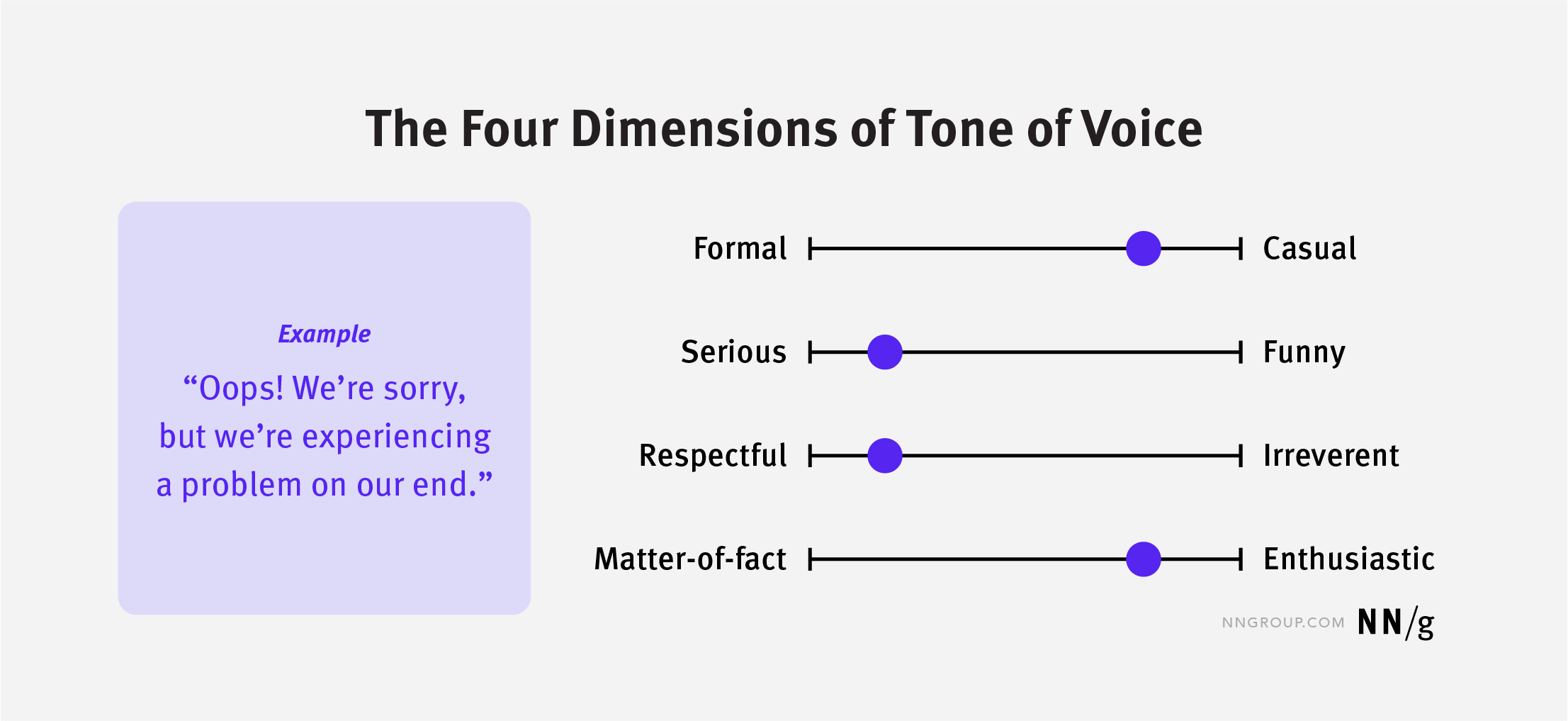
Dimensional frameworks
Provide shared vocabulary, (formal vs casual, serious vs funny) but are descriptive, not directive.
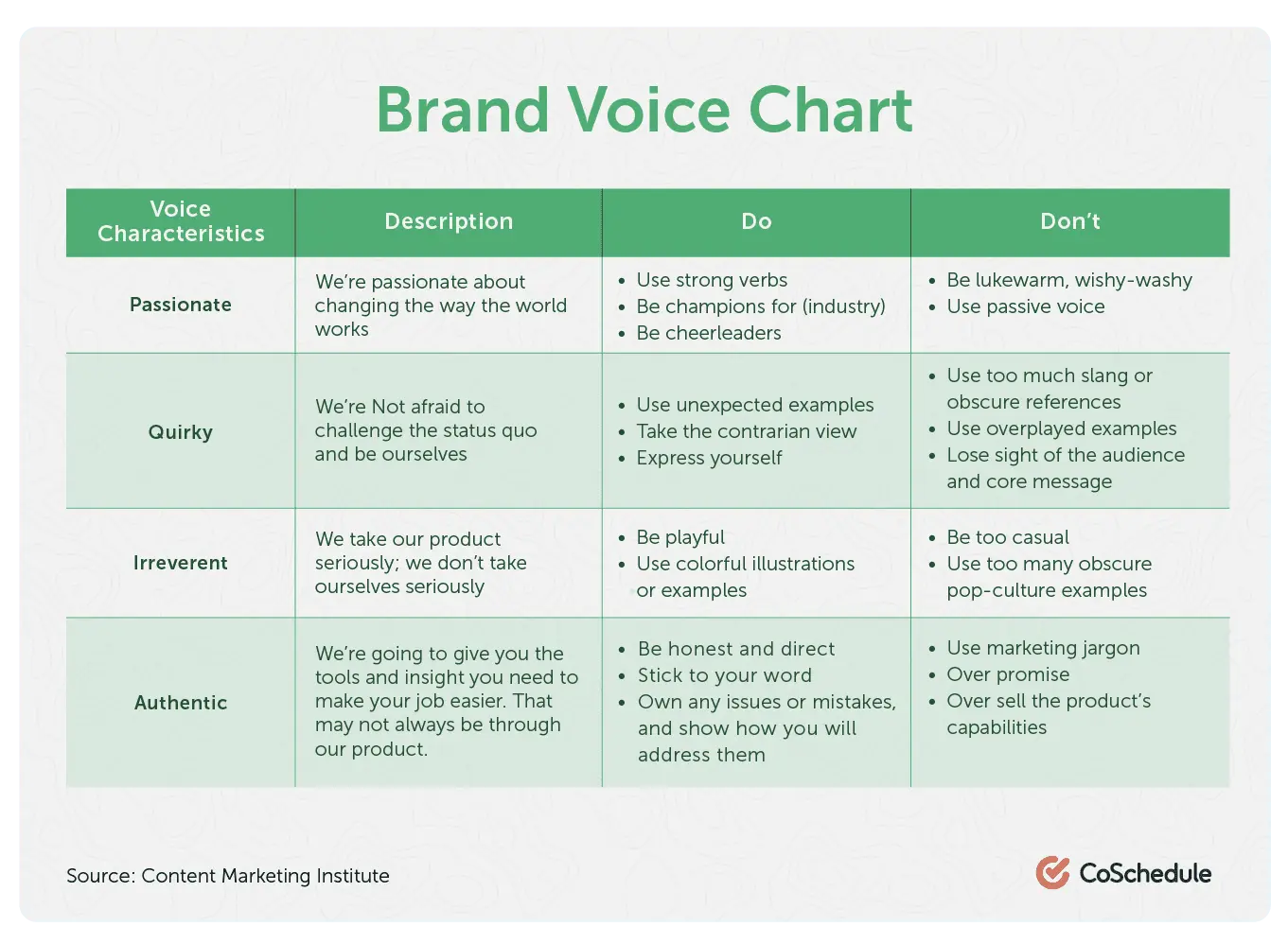
Do / Don’t charts
Improve execution, but depend entirely on how traits are defined.
Archetype models
Creates emotional coherence, but remain abstract without language rules.

Context-driven modulation
reflects reality, but assumes a strong core voice already exists.

All help teams talk about tone. None resolve conflict under pressure.
A functional tone of voice must act as a constraint system. It must narrow the range of acceptable language so decisions become clearer, not harder. That clarity comes from strategy.
What a complete tone of voice system includes
A usable system documents:
- — Clear tone pillars
- — Do and Don’t guidance
- — Vocabulary preferences and banned language
- — Rules for claims and proof
- — Real examples of correct and incorrect usage
This transforms tone from opinion into infrastructure.
Tone across channels
Consistency does not mean sameness. Tone should adapt to context without breaking voice. When tone is well defined, these shifts occur naturally. When it is not, each channel becomes a reinvention.
Tone of voice in the age of AI
AI has made tone non-optional. Without constraints, AI produces fluent but generic language. With a defined tone system, AI becomes a multiplier rather than a threat.
AI does not replace tone.
It reveals whether a brand has one.
Implementation and measurement
Tone fails when it lives in a document. Implementation begins internally, aligning core touchpoints such as the website, sales materials, and customer communication.
Tone is working when approvals speed up, feedback becomes precise, and the brand feels settled rather than performative.
The Core Truth
Tone of voice is not how a brand sounds. It is how a brand thinks out loud. When tone is systemized, clarity scales. Trust compounds. The brand holds together.
If this article made you think about your own brand, that's worth a conversation.
Book a Free Vision Clarity Session →