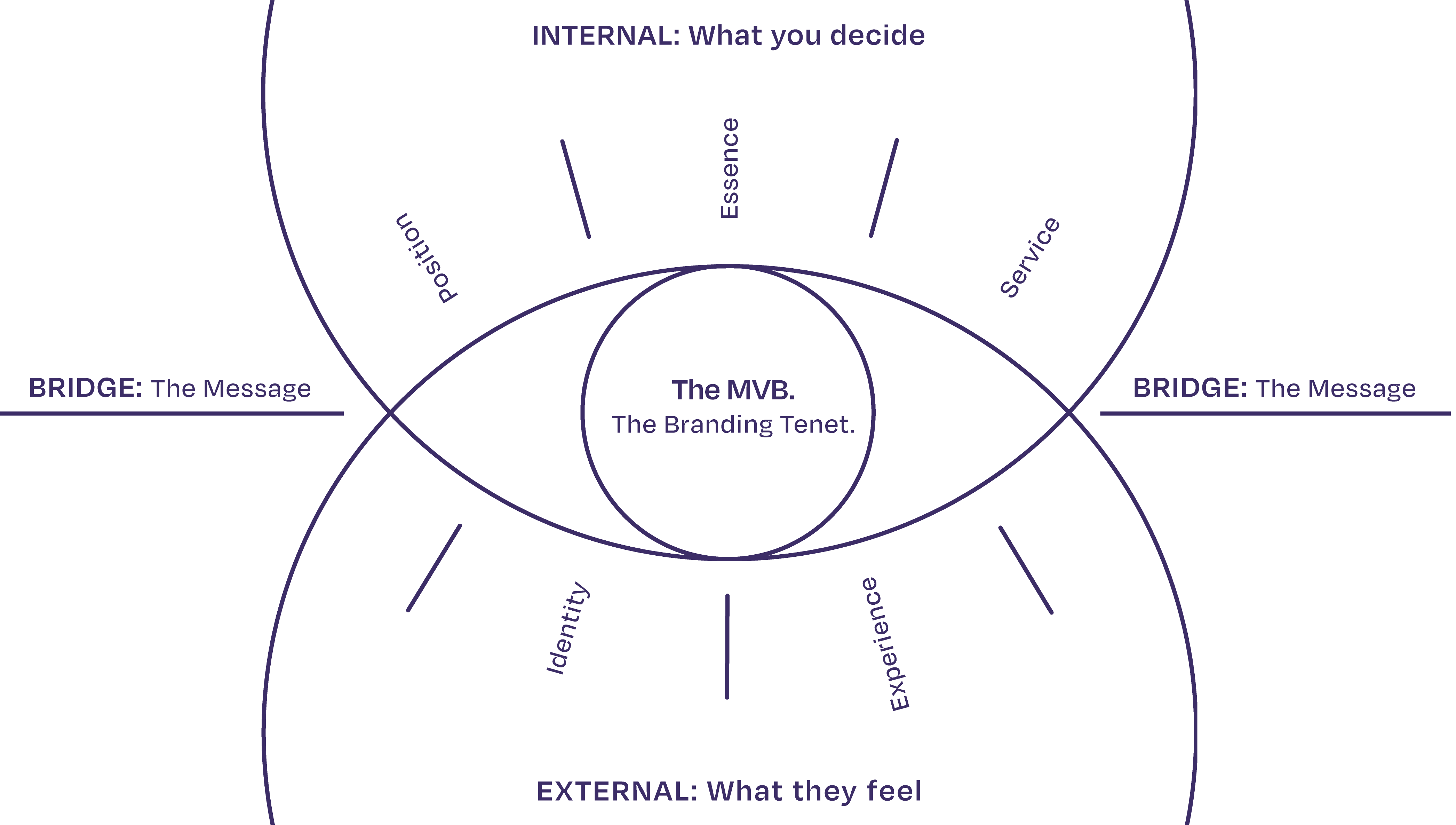
A Minimum Viable Brand isn't a cheaper version of brand strategy. It's the right-sized one. Three internal decisions. Your position, your essence, your service promise, connected by a bridge layer that carries those decisions into consistent external expression.
Build the internal world first. Build the bridge. Then let the identity and experience reflect something real.
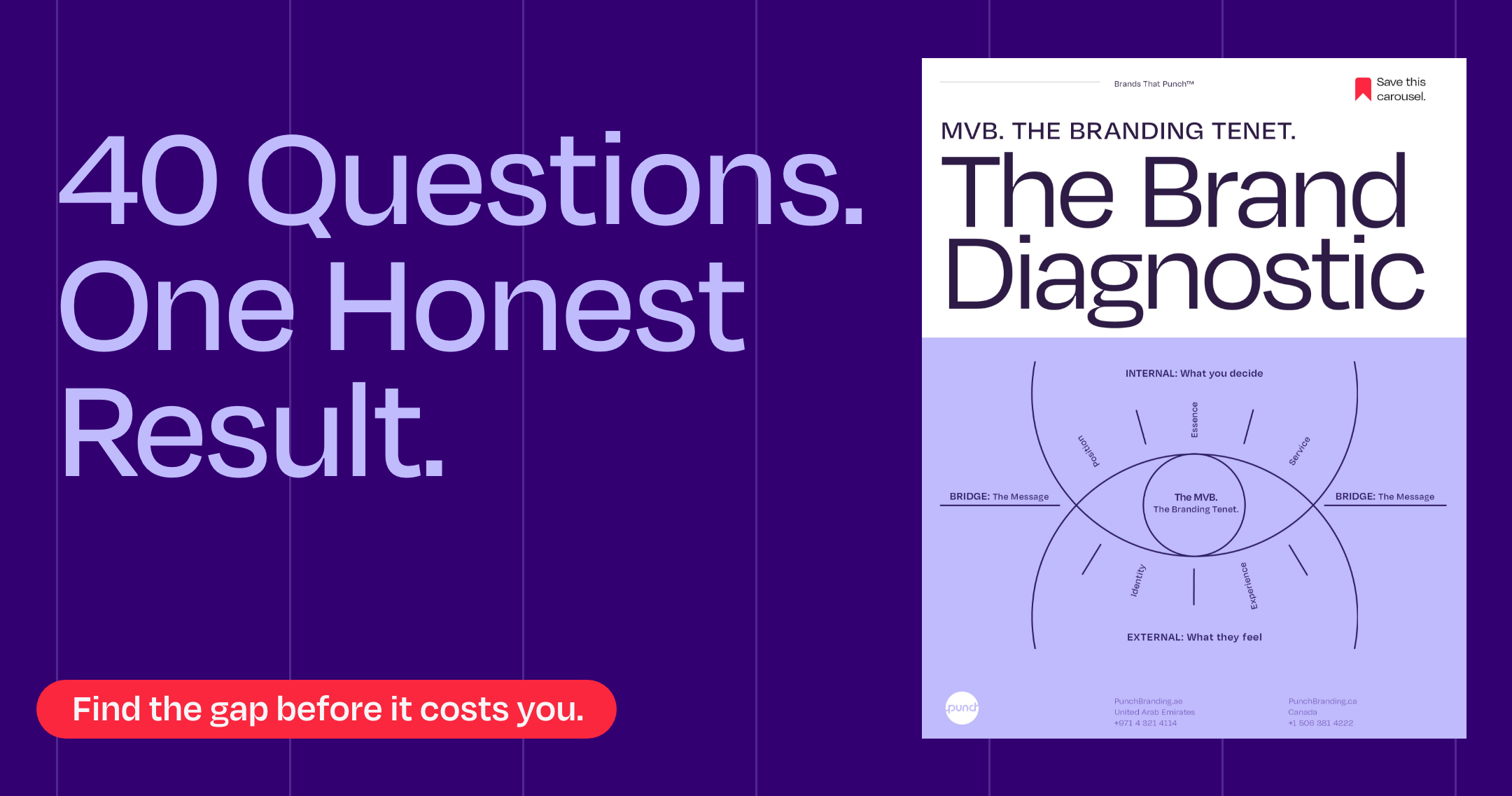
The MVB Branding Tenet Diagnostic at the end scores your brand layer by layer, so you know exactly where the system is missing, not just whether it is.

At some point in the first few years of building a business, most founders do the same thing. They hire a designer, get a logo, pick some colours, maybe write a tagline, and call it done. The brand is built. Time to grow.
Then something starts to feel off.
The marketing isn't landing the way it should. Different people on the team describe the company in different ways. A competitor with an inferior product seems to be winning more deals. Customers come in but don't stay. The business is working, but the brand feels like it's working against it, or at least not working for it.
The instinct at this point is usually to refresh the logo. Redo the website. Hire a content person. Spend more on ads. None of it fixes the problem, because none of it addresses what's actually missing.
What's missing isn't better design. It's the system underneath the design, the decisions a brand needs to function, before it can look or say anything at all.
That system has a name. It's called a Minimum Viable Brand — the MVB. And it's the thing most businesses skip entirely while spending heavily on everything it's supposed to support.
The idea already exists in product
If you've ever built or shipped a product, you know what a Minimum Viable Product is. You don't build the full platform before you've sold anything. You build the smallest version that actually works, the core function, nothing extra — get it in front of real customers, and let the market tell you what to build next. It's not a cheap product. It's not an unfinished one. It's the smallest complete one.
The logic is airtight. Don't spend on what you haven't validated. Build the core first. Expand once you know it holds.
Nobody questions that logic for product. The same founders who'd never ship without core functionality will build a brand that's all surface — a logo, a colour palette, a website that looks good — with no strategic thinking underneath any of it. Then they wonder why the marketing doesn't compound, why the team sounds inconsistent, why growth feels harder than it should.
An MVB applies the same discipline to brand: build the smallest version that's still whole, not the smallest version that's still cheap. The difference between those two things is the difference between a brand that works and one that just looks like it does.
What an MVB actually is
A Minimum Viable Brand is the smallest complete brand-system a business needs to operate credibly and consistently. Complete is the operative word. Not stripped down. Not cheap. Not a placeholder to fix later. The decisions that have to exist before the brand can mean anything, before the logo, before the marketing, before the hiring.
Here's a distinction most founders never encounter: a brand can be small and still be whole. It can also be expensive and still be hollow. Budget and completeness are not the same thing. Most businesses assume a bigger spend produces a more complete brand. It doesn't. It produces a more decorated one. Completeness comes from sequence — the order you build things in — not from what you spend.
A brand is not a logo. A logo is what a brand looks like. The brand itself is the system of decisions that tells the logo what to mean, tells the team what to say, tells the customer what to expect. Without that system, the logo is just a mark. The website is just a page. The marketing is just noise with a colour palette.
An MVB builds that system, just the non-negotiable parts of it, before anything visible gets made.
Two worlds and the bridge between them
Think about your brand as two distinct worlds.
The first is internal. What you produce as a business.
The decisions about what you stand for, who you serve, what makes you different, and how you operate. Nobody outside the company sees this world directly. But every customer feels it in everything you do. It's the source of the brand. It either exists or it doesn't.
The second is external. What the market sees and feels.
Your logo. Your website. Your social content. The way your team talks to customers. The experience of buying from you and working with you. This is the visible world. It's what most businesses treat as the brand — and why most businesses have a brand problem they can't diagnose, because they're looking at the wrong world.
Between those two worlds sits a bridge. The mechanism that takes internal decisions and converts them into consistent external expression. Without the bridge, the two worlds never connect. The external world exists — visible, polished, occasionally impressive — but it has no source to draw from. No consistency underneath. No reason to hold together when the founder isn't in the room.
That's what most businesses have built. An external world with no internal one behind it, and no bridge between the two.
The MVB fixes the sequence. Build the internal world first. Build the bridge. Then let the external world reflect what's actually there.
The internal world
Three decisions. None of them visible to the market directly. All of them felt in everything the market does see.
1. Your position. What only you can claim.
Every business competes in a category. The question isn't whether you're good at what you do — it's whether you can name the one thing you do that a competitor couldn't honestly claim tomorrow. Most businesses can't. They describe themselves in language every competitor in their space also uses: experienced, reliable, results-driven, client-focused. That's not a position. That's a category standard. Your position is what makes you the only choice for a specific customer in a specific situation — and it needs to be true, provable, and yours alone. Without it, everything the brand says is guesswork.
2. Your essence. The principles that don't move.
Markets shift. Teams grow. Offers evolve. The businesses that stay consistent through all of it have something the others don't: an internal compass. A small set of principles — two or three at most — that define how the business operates regardless of external conditions. Not values written on a wall. Principles that have actually stopped a bad decision. That have cost the business something to uphold. These are the essence of the brand. Skip them and every new hire, every new channel, every new campaign pulls the brand in a slightly different direction. Over time, slightly different becomes completely unrecognisable.
3. Your service. Where the promise meets reality.
This is the most overlooked layer in any brand-system, and the most felt by customers. It's the honest answer to: what do we actually deliver, and does it match what we say we deliver? A business that promises one thing and delivers another doesn't have a messaging problem. It has a trust problem. And trust is the most expensive thing to rebuild. Before the brand says anything publicly, this gap needs to be closed — or at minimum, acknowledged. Marketing across an unresolved service gap doesn't accelerate growth. It accelerates churn.
These three decisions are the internal world of the brand. Build them well and everything that comes after reflects their strength. Skip them and everything that comes after reflects the gap.
The bridge
Once the three internal decisions exist, the brand needs a way to carry them into the world. That's the bridge, your message layer.
Message is different in nature from the three decisions below it. It's not a decision about what the brand is. It's a translation of decisions already made, taking the position, the principles, and the service promise, and converting them into the consistent language the brand uses across every channel, every team member, every customer conversation.
This is why so many businesses sound inconsistent. The founder talks about the company one way. The sales team talks about it another. The website says something slightly different again. There's nothing agreed-on underneath the language, so the language drifts toward whoever wrote it last.
Message without a source isn't brand language. It's copywriting. It sounds good in isolation and means nothing in aggregate. The bridge only holds if there's something on the other side of it.
Build the bridge after the internal world is in place — not before. Then it becomes the mechanism that keeps the whole external world consistent, regardless of who's writing, selling, or posting.
The external world
The external world is what your customers actually encounter. The logo. The website. The visual identity. The experience of buying from you, onboarding with you, working with you over time. This is the world most businesses pour their budget into — and the world that means nothing without the internal one behind it.
4. Your identity. Strategy made visible.
The logo, the colour palette, the typography, the visual system. When these are built after the internal decisions are locked, they carry meaning they didn't have to manufacture — because they're expressing something real. When they're built first, as they usually are, they express nothing but preference. A logo built before the position is clear is a logo you'll eventually replace. Not because it aged badly — because it was never anchored to anything that couldn't change.
5. Your experience. Where the brand is proved or broken.
Every touchpoint a customer has with you adds up to an experience of the brand. How it feels to enquire, to buy, to onboard, to get support, to come back. This is the fullest expression of everything in the internal world — and the most exposed layer of the whole system. A customer who has a consistent, credible experience is feeling a well-built internal world working exactly as it should. A customer who has an inconsistent one is feeling the gap between what the brand promised and what the system actually produces.
The external world matters enormously. It's also the world that should grow with the business — not before it has a source to draw from. Build the internal world and the bridge first. Then build the external world knowing it has something real to reflect.
Why this matters
There's a version of this advice that sounds like permission to under-invest. It isn't. It's the opposite.
A startup or early-stage business has the least room for waste and the most exposure to compounding mistakes. Every dollar spent building the wrong identity before the Onlyness is locked is a dollar you'll spend twice, once to build it, once to undo it. Every hire who joins without a clear Essence to align to becomes one more voice describing the company differently. Every piece of content published before the Message bridge is built adds noise you'll later have to clean up.
Strong brands compound. Research from Kantar BrandZ has shown that strong brands capture roughly three times the sales volume of weak competitors and can command a price premium upward of 13%. That compounding doesn't start when you finally afford the full system. It starts the moment the internal world is in place, because compounding requires consistency, and consistency requires decisions that have already been made.
The MVB isn't a discount version of brand strategy you graduate out of once you can afford better. It's the source the rest of the system draws from, at any size. Apple's MVB in a garage was a point of view about what computers should be for ordinary people, not a logo, not an experience design, a position. The identity came later. The position came first, and it never moved.
What an MVB is not
A few things worth being direct about, because this is where most founders get stuck.
It's not a smaller logo project.
If the output is still a mark and a colour palette, you haven't built an MVB. You've built the external world without the internal one. Same mistake, lower invoice.
It's not a temporary fix.
The internal world you build now doesn't get thrown away when the business grows. It becomes the source the full brand-system draws from at every stage. You're not starting over later — you're building on this.
It's not branding on a budget.
Cheap branding cuts corners on craft. An MVB cuts scope, not quality. The internal decisions and the bridge get full attention. The external expression gets only what the business needs right now — no more, no less.
It's not a replacement for proper strategy.
It is proper strategy — just concentrated. The hardest thinking happens here, without the comfort of a beautiful visual system to hide behind.
Who needs an MVB
If any of these sound like your business, this is the right place to start — not as a lesser version of brand strategy, but as the right-sized one:
1. You're in the early stages
and need to operate consistently before you can justify a full brand build.
2. You've grown past founder-led sales
and now have a team describing the company in different words.
3. You're about to spend on marketing or hiring
and want the internal decisions made before that spend compounds inconsistency.
4. You have brand assets, a logo, a website, some content
but no underlying decisions anyone agreed on.
5. You know what makes you different.
You've just never written it down, tested it, or made it usable for the people around you.
None of these require six figures or six months. They require three decisions and a bridge, made in the right order.
How to build yours
This is deliberately practical. Four steps, in order. Don't skip ahead — each one depends on the one before it.
1. Define your position.
Start with the hardest question in brand strategy: what do you do that a direct competitor couldn't honestly claim? Not a better version of what they do — something categorically yours. Write it down as specifically as you can. Then test it: could your closest competitor say this tomorrow without lying? If yes, it's not your position yet. Keep narrowing until it's genuinely yours.
2. Name your principles.
Identify two or three things about how you operate that will still be true in ten years. Not aspirations. Things that are already true — that have already cost you something to uphold, that have already shaped a decision. These become the internal compass every team member navigates by, without needing to check with you first.
3. Close the service gap.
Write down what you promise customers, then write down what you actually deliver. Compare the two columns honestly. Wherever they don't match — that's the gap the market is already feeling, whether you know it or not. Fix it or acknowledge it before you market across it.
4. Build the bridge.
With the three internal decisions in place, set the language rules your brand operates by. What you always say. What you never say. How you describe what you do in one sentence. Not a full messaging document — just enough that two people on your team, writing independently, sound like the same company.
That's the MVB. Three decisions and a bridge. Everything beyond it — the logo, the visual identity, the full customer experience — can be built, scaled, and evolved. But only once there's something real for it to reflect.
The Brand Diagnostic
We built the MVB Diagnostic, a FREE download to help you diagnose where you are before you decide what to build next. Forty yes/no statements across the six MVB layers — scored per layer so you can see exactly where the gap is, not just whether one exists.
The point of starting whole
An MVP isn't a smaller product. It's the proof that the core idea works before you spend on everything around it. An MVB is the same proof, applied to brand — the smallest version of your brand-system that's still whole enough to produce a consistent external world.
Most businesses don't fail because their brand was too small. They fail because what the market saw had no source. A beautiful external world with nothing behind it isn't a brand. It's a surface.
Build the internal world first. Build the bridge. Then let the reflection take care of itself.
This article is part of the Brand Operating System series. For the full six-layer framework, read What is a Brand Operating System.
If this article made you think about your own brand, that's worth a conversation.
Book a Free Vision Clarity Session →