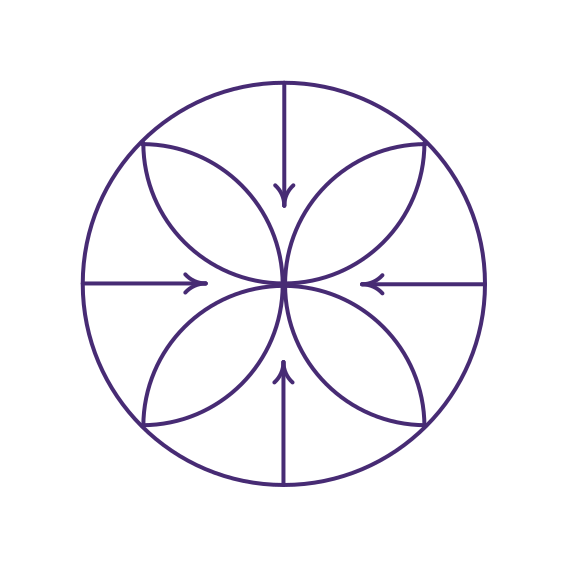
Most brands have a positioning statement. Almost none have a position. The Punch is your brand's verified onlyness, the one territory no competitor can claim with equal credibility.
You find it by mapping three forces simultaneously: what your company can credibly deliver (Company), what your customer actually needs (Customer), and what no competitor has already taken (Competitor). Where all three intersect is your ownable space.
You articulate it using the Only-ness Statement frame — "We are the only [WHAT] that [HOW] for [WHO] in [WHERE] when [WHEN] so they can [WHY]." — then pressure-test it against the Kill Test.
If a competitor could say the same thing with equal credibility, it isn't the Onlyness. When it passes clean, that's The Punch. That's what everything else gets built around.

Most brands have a positioning statement. Almost none of them have a position.
A positioning statement is a sentence in a document. A position is a place in the customer's mind, a specific territory that belongs to one brand and no other.
Most businesses have never been to that territory. They've written sentences about it. Put it in a deck. Presented it in a boardroom. But the sentence and the territory are not the same thing, and until the position is real — verified, evidenced, tested — it's just words that sound like strategy.
This is the process that makes it real.
What is 'The Punch'.
At the centre of every Brand Operating System is The Punch. Not a tagline. Not a mission statement. Not a value proposition.
Finding your Onlyness is the most important thing a brand can do. When you know it — really know it — everything you say has Punch. That's why we named the agency Punch. And that's why we call the verified onlyness at the centre of every brand we build The Punch.
The Punch and the Onlyness are the same thing — the single verified position at the centre of everything the brand builds around.
It isn't what the brand wants to say. It's what the brand can prove.
The one specific, defensible territory that belongs to this brand alone — not because someone decided it should, but because the evidence points there and nowhere else.
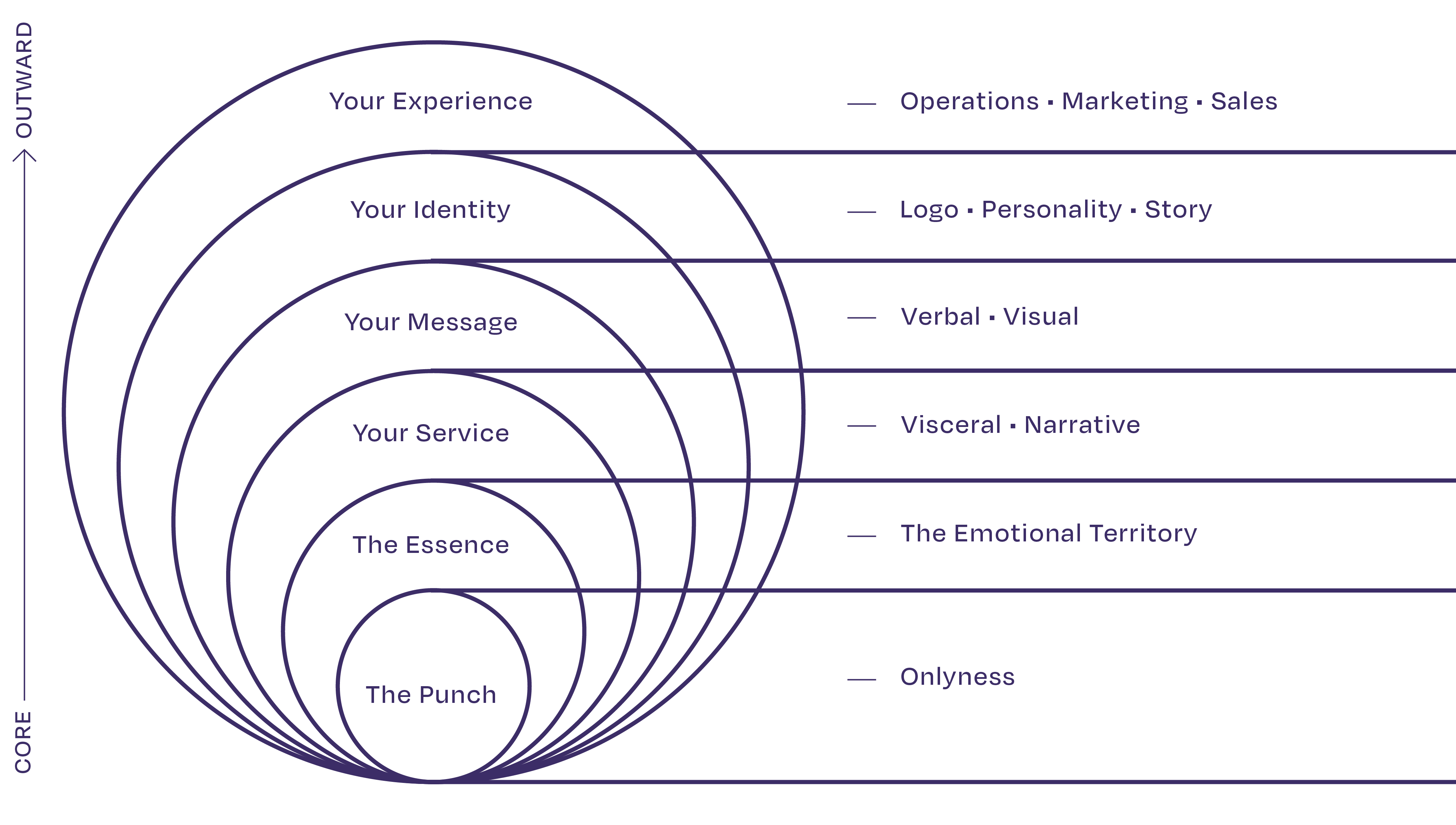
The Punch/the onlyness sits at the core of a six-layer Brand Operating System. Every layer that follows — The Essence, Your Service, Your Message, Your Identity, Your Experience — radiates outward from it. The further out you build, the more visible the brand becomes.
But visibility without a verified core is just noise.
Most brands start at the outside and work in. They build the identity first — the logo, the colours, the story — and hope the position emerges from it. It never does. The Punch has to come first. Everything else is built around it.
You can feel the difference between a brand that has it and one that doesn't.
A brand with 'The Punch' knows exactly who it's for and exactly what it's not. It doesn't chase every opportunity. It doesn't try to be everything to everyone. It makes decisions quickly — because every decision gets measured against the same centre. Does this reinforce the position or dilute it?
A brand without 'The Punch' drifts. The marketing changes tone every quarter. The sales team describes the business differently depending on who's in the room. The rebrand doesn't stick because there was nothing solid to rebrand around. The pricing stays soft because there's no clear reason why this business specifically — not just any business in the category.
Most businesses skip this step entirely. They move straight to the logo. They write a mission statement that sounds like every other mission statement in their category. They run campaigns that can't explain why a customer should choose them specifically over the business next door.
The result is a brand that looks finished but was never actually built. A shell with nothing inside it.
Why onlyness, not difference
Being different isn't enough. Being better isn't enough.
Most businesses can point to something that makes them different. A faster turnaround. A friendlier team. A more considered process. The problem is that "different" and "better" are claims almost every competitor can also make — and often does, in almost identical language. Go to the websites of any five businesses in the same category and count how many times the words "quality," "experience," "passionate," and "results-driven" appear. They're everywhere. They mean nothing. And that's not a copywriting problem. It's a positioning problem.
Onlyness is a higher bar. It's not "we're different." It's "we are the only one who can credibly say this."
That's a much smaller list. Sometimes a list of one. And that specificity is exactly what makes it powerful.
When a brand occupies a genuine onlyness, it stops competing on comparison and starts winning on its own terms. Pricing power increases, because there's no direct substitute to compare against — the customer isn't choosing between options at the same price point, they're deciding whether the unique value is worth the investment. Referrals improve, because customers know exactly who to send and exactly what to say when they send them. Marketing gets cheaper and more effective, because a specific message converts better than a vague one, always.

Without onlyness, a brand is just another option in a list the customer is already tired of scrolling through. With it, the brand becomes the only choice that makes sense for the right customer, and "the right customer" stops feeling like a lucky accident and starts feeling like a system.
Most founders who reach this point feel two things at once. Relief, that there's a process for finding it, that the Onlyness isn't invented in a brainstorm or handed down from a consultant's slide deck. And a quiet unease, that when the process is done, the answer might be smaller than they hoped, more specific than they're comfortable committing to.
Both are normal. The Onlyness is almost always more precise than expected. And that precision is exactly what makes it real.
A position specific enough to exclude someone is a position specific enough to mean something. That's not a limitation. That's the point.
The 3C Differentiation Framework
The Punch isn't invented in a brainstorm. It's triangulated.
At BrandsThatPunch™, we find it by mapping three forces against each other, what we call the 3C Differentiation Framework: Company, Customer, Competitor.
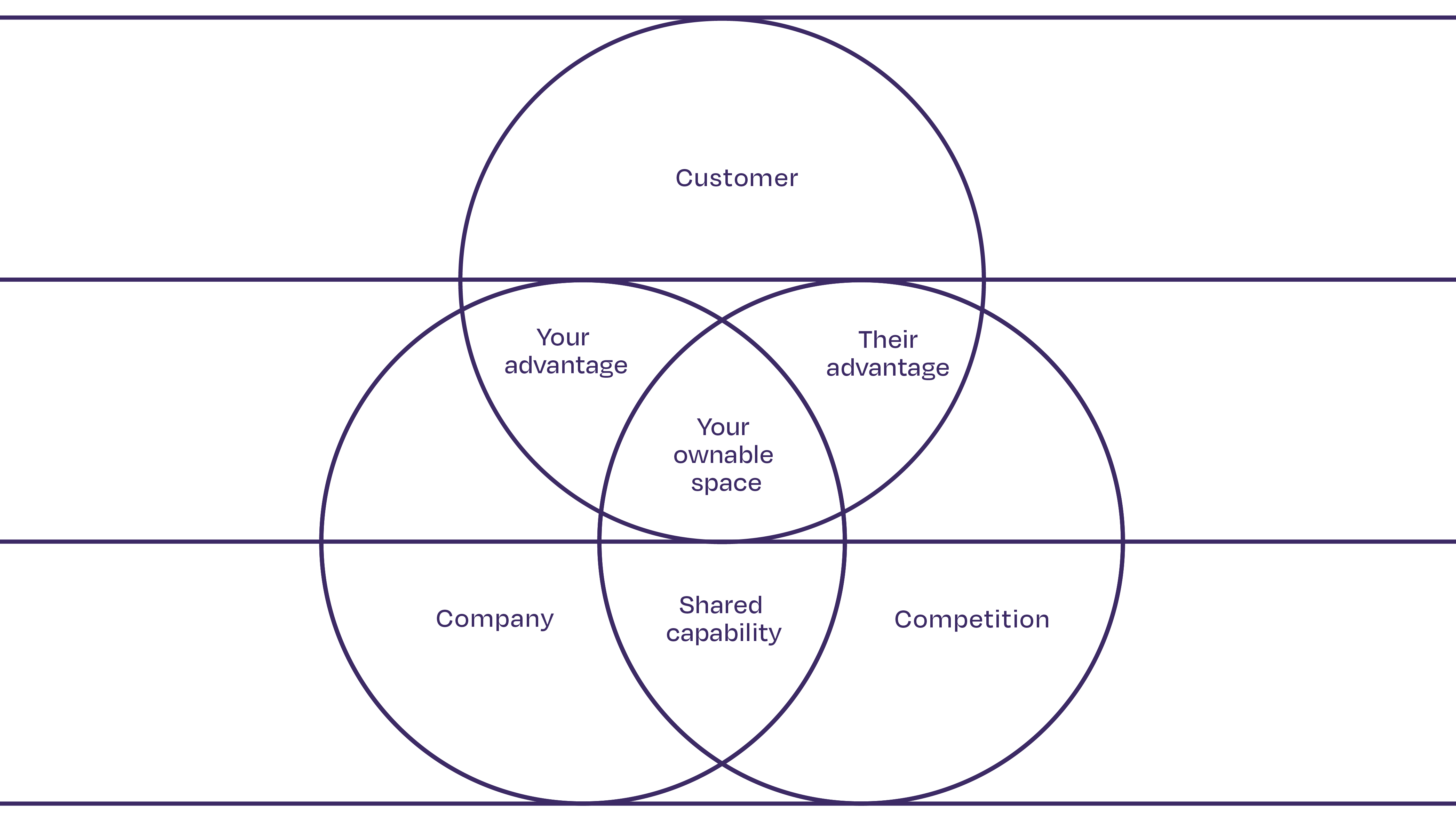
The Onlyness lives in the space where all three intersect: something the company can credibly claim, that the customer actually cares about, and that no competitor has already taken.
Miss any one of the three and the position fails. Claim something the company can't back up, and it collapses under questioning. Claim something the customer doesn't care about, and it falls flat in market. Claim something a competitor already owns, and you're just echoing them louder at your own expense.
The 3C Framework eliminates guesswork. Each C is a filter. By the time all three have been mapped honestly, the space available for a genuine onlyness is usually smaller than expected, and far more valuable than anything the brainstorm produced.
Company:
The Entrepreneur Sweet Spot
Every brand inherits something from the person who built it. This is where that inheritance gets mapped.
The Entrepreneur Sweet Spot is a three-force model: what you're genuinely good at, what you love doing, and what the market actually needs. Most founders can answer the first two easily. The third one is where honest thinking is required — because "what the market needs" is not "what we'd like the market to need." It's what customers are actively looking for, willing to pay for, and currently underserved on.
Where all three forces intersect is the strategic core — the space where this business has the earned right to win, not just the desire to.
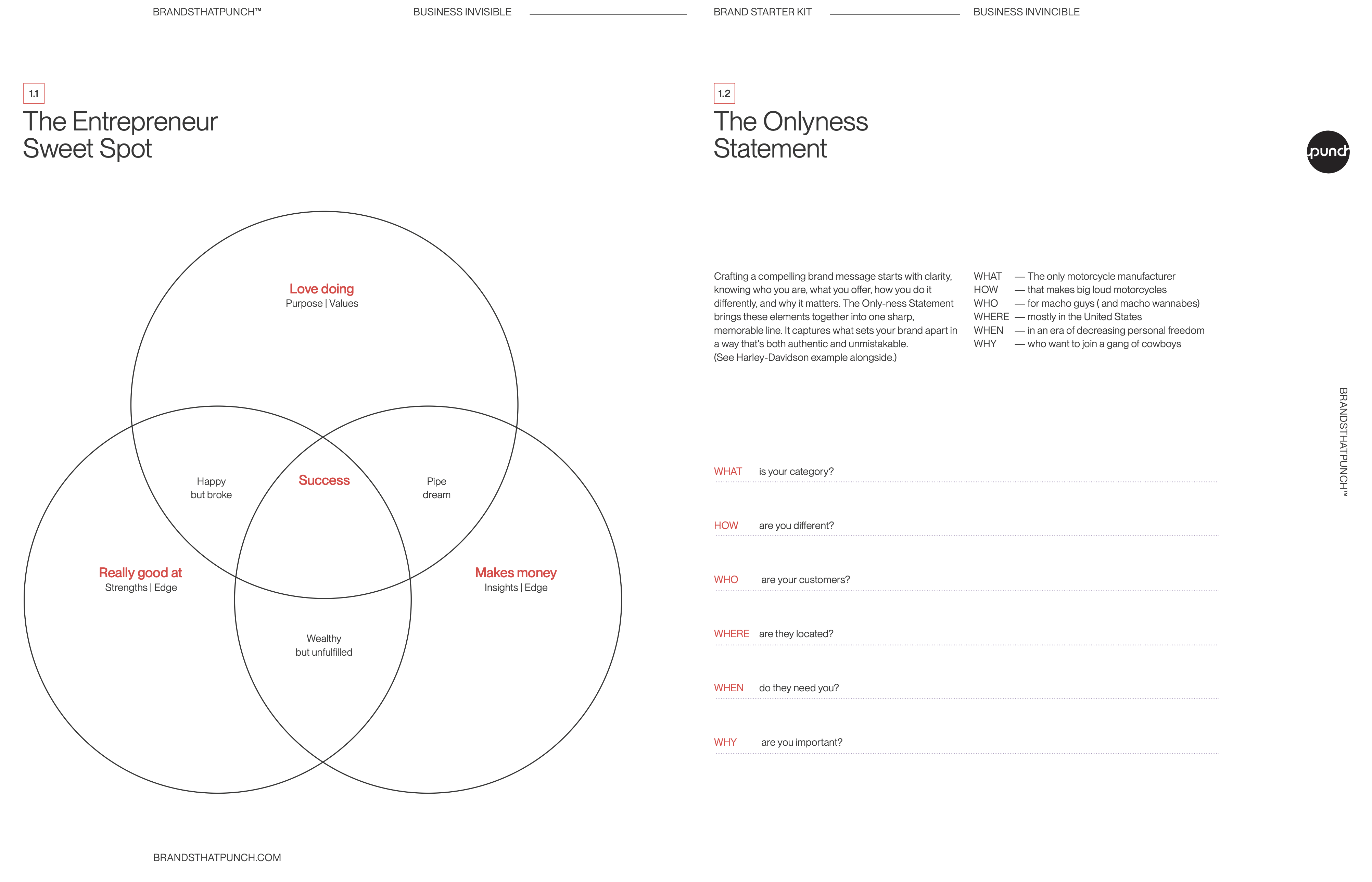
But the model goes deeper than the centre. The intersections between pairs of forces reveal four things worth knowing, and each one sharpens the Onlyness in a different way:
Why — where Good At meets Love Doing. This is the brand's purpose. The reason the business exists beyond commercial necessity. It's not invented for a brand document. It's already true — most founders just haven't articulated it yet.
How — where Love Doing meets Market Need. This is the way the brand works. The experience clients feel when they engage. The process that makes delivery distinctive. The approach that separates the brand from competitors who offer nominally similar services but work completely differently.
Your Edge — where Good At meets Market Need. This is the competitive advantage — the specific capability the market values and this business delivers better than the alternatives. The Edge is often where the Onlyness begins to take real shape. It's the intersection of what you're built for and what the market is actually buying.
What — the centre of all three. The offer. What the business actually does — defined not by service category but by strategic intent.
This isn't a personality exercise. It's a filter. It tells the brand what it can credibly claim — the raw material the Onlyness will eventually be built from. A position the company can't actually deliver on isn't a Punch. It's a promise waiting to be broken the moment a client puts real pressure on it.
Customer:
The Empathy Map
A position the customer doesn't care about isn't an Onlyness. It's a brag.
The Customer Empathy Map builds a precise picture of how the target audience actually thinks, feels, and behaves — not who the brand hopes they are, but who they demonstrably are. It maps six dimensions of experience: what they think and feel (their inner world), what they see (the environment they operate in), what they hear (the voices and influences around them), what they say and do (their visible behaviour), and beneath all of that — their pains and their gains.
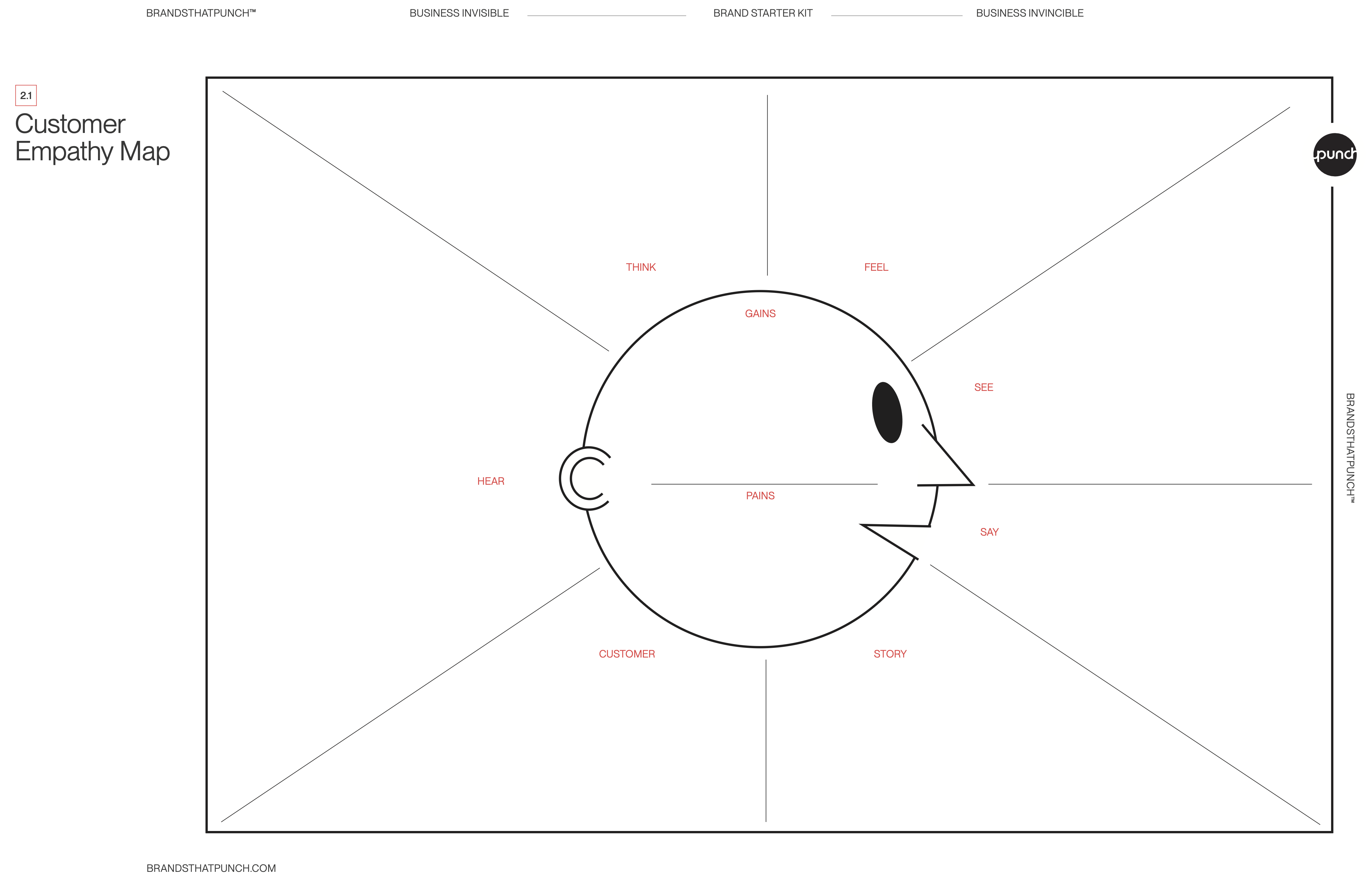
The pains are the frustrations, fears, obstacles, and risks they're trying to avoid. The gains are the outcomes they want, the measures of success they're working toward, the things that would make the problem feel solved.
This is where most positioning quietly fails. Brands claim positions their customers never asked for and then wonder why the message doesn't convert. The Onlyness has to connect to something real on the customer's side — a genuine pain being relieved or a meaningful gain being delivered. Not something the business is proud of. Something the customer actually feels.
A common mistake here is mapping the customer the brand wants rather than the customer it has — or should have. The best version of this exercise is built from real evidence: client conversations, sales call patterns, feedback, reviews, the language customers actually use to describe their problem before they've encountered the brand's language for it. That language is gold. The Onlyness should eventually sound like something the customer was already thinking, finally said out loud.
Competitor:
The White Map
Every market has gaps. Most brands never bother to find them.
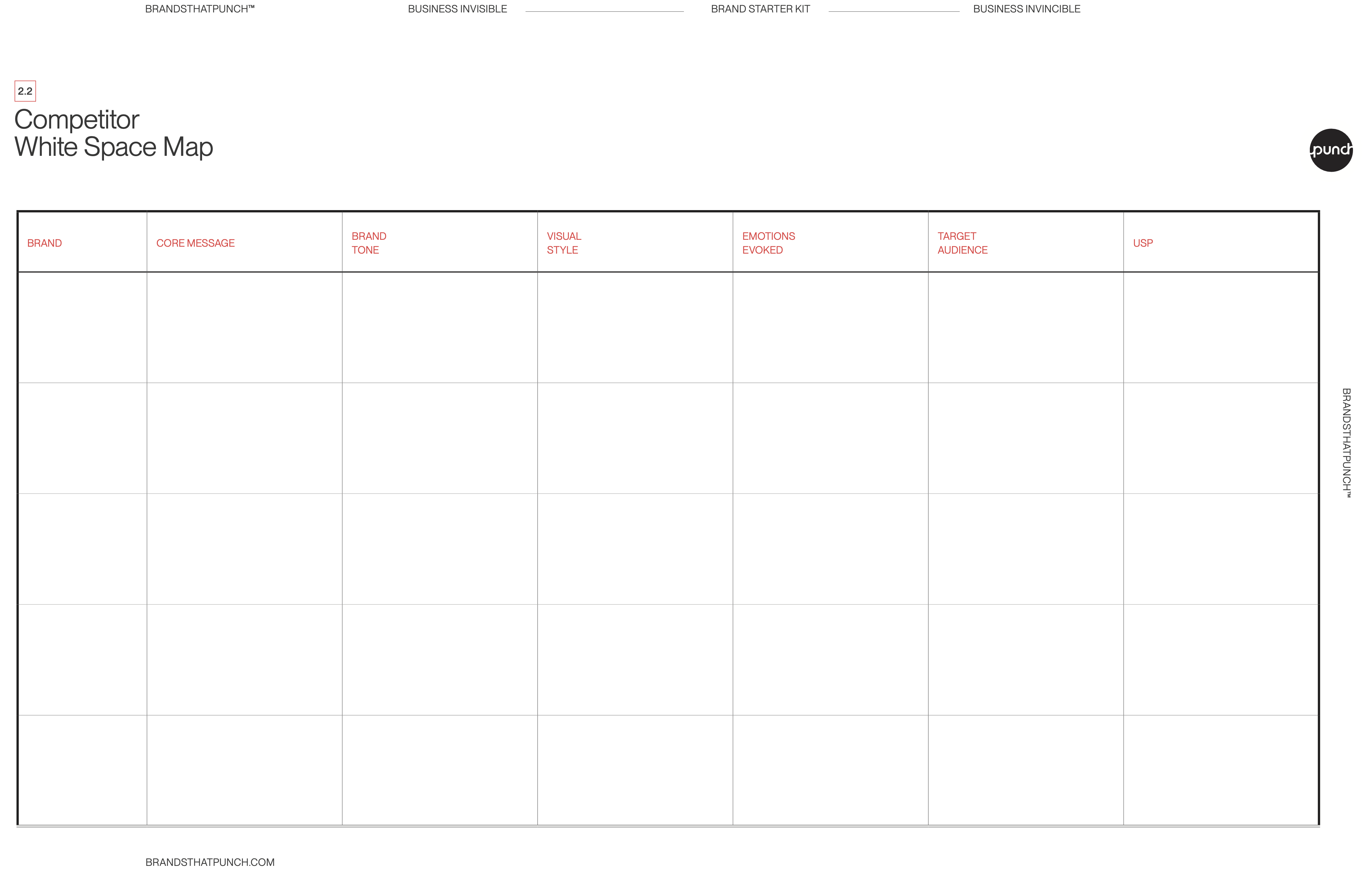
The Competitor White Map looks at what competitors are actually claiming — the position they own, the language they repeat, the territory they've staked out in the customer's mind. Then it looks at what they're leaving open.
The mapping process is deliberate. For each significant competitor, identify four things:
What position do they own? Not what their website says — what a customer would actually say if asked to describe them in one sentence. These are different things, and the gap between them is revealing.
What proof do they offer for it? Case studies, credentials, testimonials, track record. This tells you how defensible their position actually is — and where the evidence is thin.
Who are they explicitly targeting? The customer they talk to in their marketing, the language they use, the problems they position themselves against.
What do they consistently ignore? The customer need they don't address, the claim they never make, the segment they don't serve. This is the most important column on the map — and most brands never fill it in.
The ignored territory doesn't disappear just because a competitor chose not to stand in it. It sits there, available, waiting for the brand willing to claim it credibly.
The most valuable white space is the territory a competitor can't enter without fundamentally changing what they are. A fast-food chain can't credibly claim slow food. A volume agency can't credibly claim bespoke. A budget brand can't credibly claim premium — at least not without rebuilding everything. That structural inability is what makes the white space genuinely ownable, not just temporarily vacant.
If every competitor in the category is claiming quality, experience, results, and passion — none of those things are the Onlyness. They're category requirements. The price of entry. What the market expects from every serious player before the conversation even begins.
The Onlyness lives in the space nobody else is standing in — and more importantly, the space nobody else can credibly enter.
Where the three meet
Run Company, Customer, and Competitor side by side and a pattern emerges: a small number of things the company can credibly claim, a small number of things the customer actually cares about, and a small number of territories no competitor has already taken.
The Onlyness is your ownable space — relevant to the customer, true to the company, and unclaimed by the competition.
Bridge from 3C to Articulation
The moment the Onlyness appears
Running the three Cs side by side is rarely a sudden revelation. It's more like a narrowing. Each filter eliminates territory — positions the company can't back up, positions the customer doesn't care about, positions a competitor already owns. What's left when all three filters have done their work is smaller than expected.
That's the point.
Most founders, when they first see it, feel two things simultaneously: recognition and exposure. Recognition because the position was always true — it was there in the way the best clients describe the business, in the work the team is proudest of, in the moments where the business feels most itself. Exposure because claiming it specifically means closing other doors. A position specific enough to be real is also specific enough to exclude some customers, some opportunities, some conversations.
That discomfort is the signal. If a position feels completely safe — if it closes no doors and excludes nobody — it isn't specific enough to be the Onlyness. It's still a category claim.
When the territory has been found, the next job is naming it. Not perfecting it. Not wordsmithing it into something that sounds like a tagline. Naming it — putting words to the space so it can be tested against reality.
Articulation, putting the Onlyness into words
Finding the space is the hard work. Naming it precisely is where most brands fumble. The Onlyness Statement uses six questions to build one clear, specific sentence about your brand.
WHAT is your category? HOW are you different? WHO are your customers? WHERE are they located? WHEN do they need you? WHY does it matter?
We are the only [WHAT] that [HOW] for [WHO] in [WHERE] when [WHEN] because [WHY].
Not every blank needs to appear in the final sentence. But you need to know the answer to all six before you can write one that holds up.
The first blank is your category.
Not so broad it means nothing. Not so narrow it limits you commercially. Specific enough to be meaningful, broad enough to be real.
The second blank is your differentiator
drawn directly from the overlap of Company, Customer, and Competitor. This is the part that does the work. It has to be specific, evidenced, and structurally unavailable to your competition.
The remaining four — WHO, WHERE, WHEN, WHY — are your context.
They sharpen the sentence and prove you know exactly who you're for and why it matters. Not every one will appear in your final statement. But knowing all four stops your Onlyness from being too generic to mean anything.
Write three versions minimum. The first is almost always too safe. The second usually goes too narrow. The third is where the real sentence tends to appear — specific enough to be defensible, human enough to be felt.
Push each version until it could only describe your business. Not a business like yours. Yours specifically.
The Kill Test
Before it becomes your Onlyness, it has to pass one question.
Could a competitor say the same thing —
with equal credibility?
If yes, it's not your Onlyness. It's a category claim. Table stakes. Worth saying somewhere, but not worth building everything around.
Common failures: "We put clients first." "We speak plain English." "We combine strategy with execution." Every competitor says these. None of them pass.
A statement specific enough to pass the Kill Test will put off the wrong customer. That's not a problem — it's the point.
The right customer, when they find you, will feel like you were built specifically for them. Because you were.
What happens next
Your Onlyness isn't a document. It's a standard.
Every decision your brand makes — what you say, how you look, what you charge, who you take on, what you turn down — gets measured against it. Does this reinforce the position or pull you back toward the middle?
Get this right and everything built around it performs. Skip it and everything built around it is decoration.
The next step is turning your verified Onlyness into a full Brand Positioning Statement, backed by proof, sharpened by insight, and locked in writing.
That's covered in the next article.
If this made you think about your own brand, let’s talk.
Book a free Vision Clarity Session